
 Text by Tom Appel
2026 Nissan Leaf Platinum+
Specs
Class: Subcompact Crossover
Country of Manufacture: U.S.
Color: Coulis Red Pearl and Super Black
Miles driven: 233
| CG Report Card | |
|---|---|
| Room and Comfort | B |
| Power and Performance | B+ |
| Fit and Finish | C |
| Fuel Economy | A |
| Value | A- |
| Report-card grades are derived from a consensus of test-driver evaluations. All grades are versus other vehicles in the same class. Value grade is for specific trim level evaluated, and may not reflect Consumer Guide's impressions of the entire model lineup. | |
| Big & Tall Comfort | |
| Big Guy | A |
| Tall Guy | A |
| Big & Tall comfort ratings are for front seats only. "Big" rating based on male tester weighing approximately 350 pounds, "Tall" rating based on 6'6"-tall male tester. | |
| Drivetrain | |
| Engine Specs | 214 horsepower |
| Engine Type | Electric motor |
| Transmission | Automatic |
| Drive Wheels | Front-wheel drive |
Battery capacity: 75 kWh
EPA-estimate MPGe: 103
EPA-estimated driving range: 259
Maximum Charge Rate: 150 kW
Consumer Guide range estimate (ideal conditions): 300+ miles
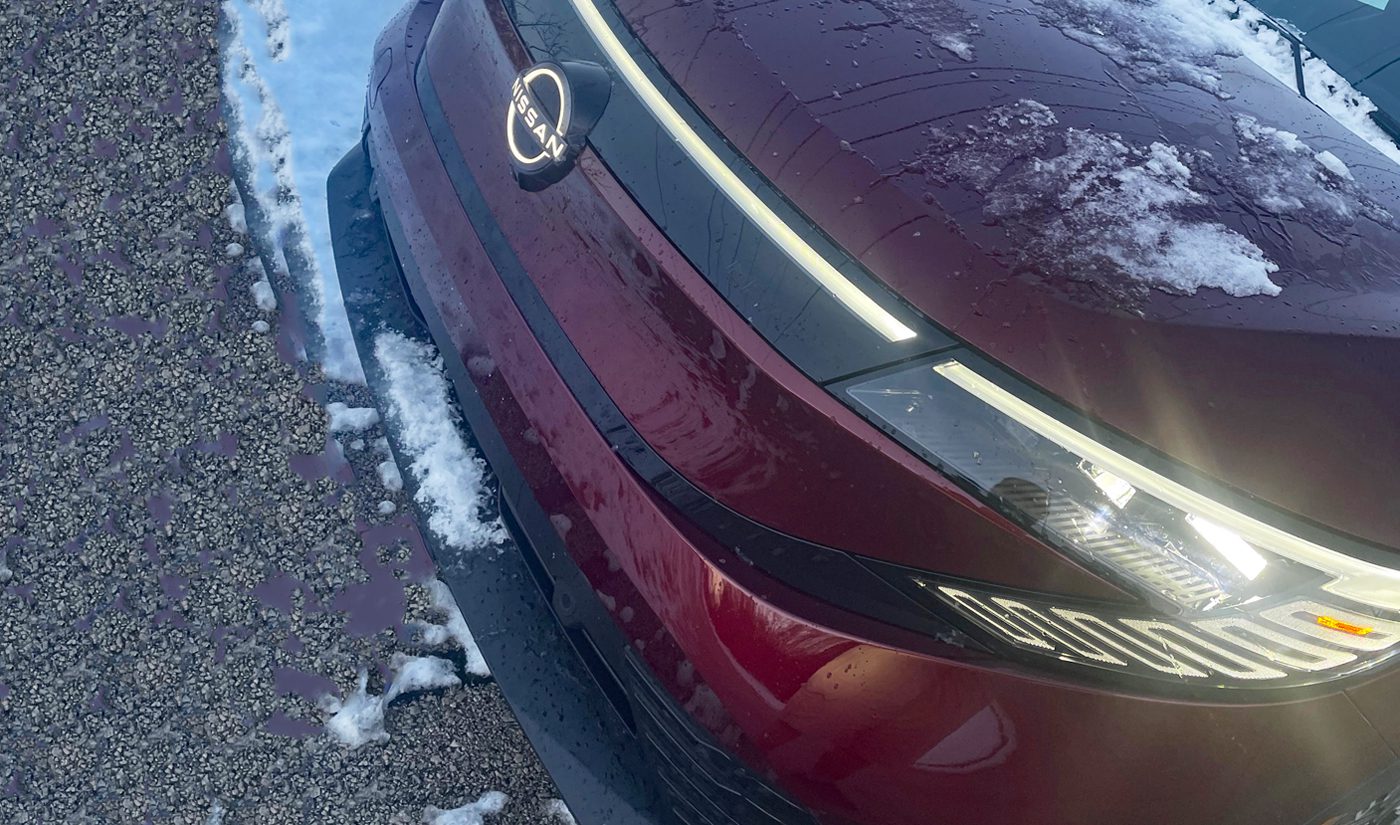
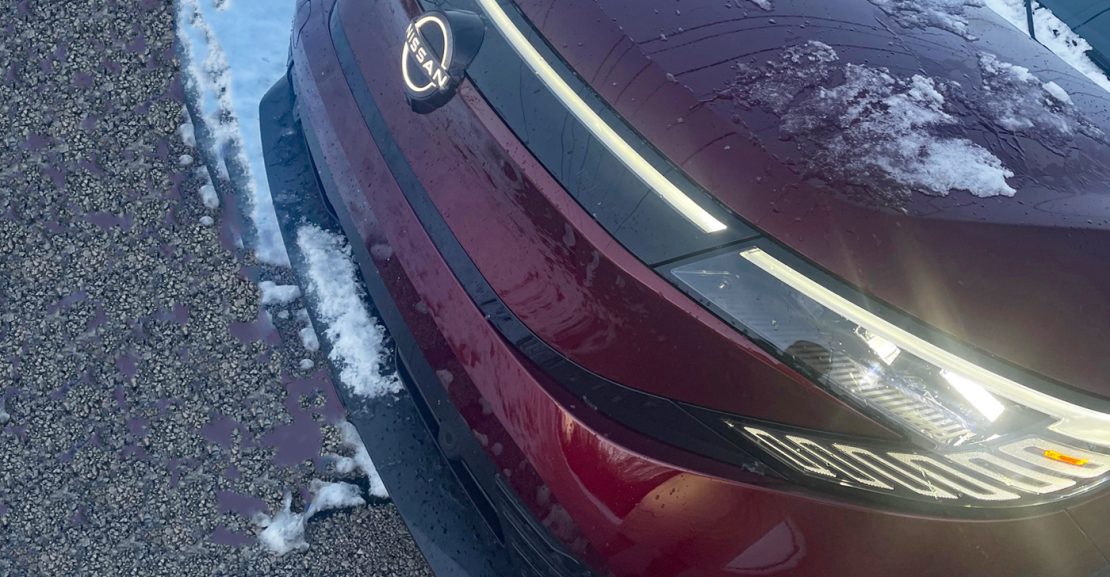
Charge Port Location: Front driver-side fender (CCS), front passenger-side fender (NACS)
Charging Standard: CCS and NACS
Snow Performance:
Poor Fair Good Very-Good Excellent
Frunk Capacity: N/A
Base price: $38,990 (not including $1495 destination charge)
Options on test vehicle: Floor Mat Package ($345), battery heater ($500), special 2-tone paint ($800)
Price as tested: $41,930
Audio-System Brand
Audio-System Quality
Poor Fair Good Very-Good Excellent
Pros and Cons
The great: Modern look and feel, value price
The good: Fun to drive, good range
The not so good: Low-grade interior materials, no AWD option
Review
If you haven’t been paying attention, you may not have noticed that the current political climate is unfriendly—arguably hostile—to those interested in selling and owning electric vehicles.
EV Headwinds
This past September the $7500 federal tax credit for EV purchasers expired, while federal spending for public charging infrastructure expansion has been stalled, and in many cased halted.
Yet, while these seem like dark days for the electric vehicle, there are some bright spots. Read the news and learn that advanced battery technology is still being explored, and that we should—possibly even this decade—see the impact of high-energy-density solid-state batteries, which promise greater range, and reduced per-unit cost.
Nissan Leaf
But until there’s a governmental regime change, and until future-tech batteries arrive, what’s a well-intended EV shopper to do today? One option is to buy a 2026 Nissan Leaf.
New for 2011, the Leaf was a pioneering EV effort, arriving on the scene at about the same time as the significantly more expensive, and more luxurious, Tesla Model X. A small, arguably ungainly hatchback, the Leaf enjoyed decent reviews from the automotive media, but its uninspiring design, limited range (initially just 73 miles), and just adequate acceleration left even green-minded consumers cold.

A 2018 redesign brought with it increased range—up to 226 miles—updated styling, and some exciting tech, including Nissan’s ProPilot semi-autonomous driving system. Still, buyers stayed away, likely looking for more range, and something other than a small hatchback.
Prices and Trim Levels
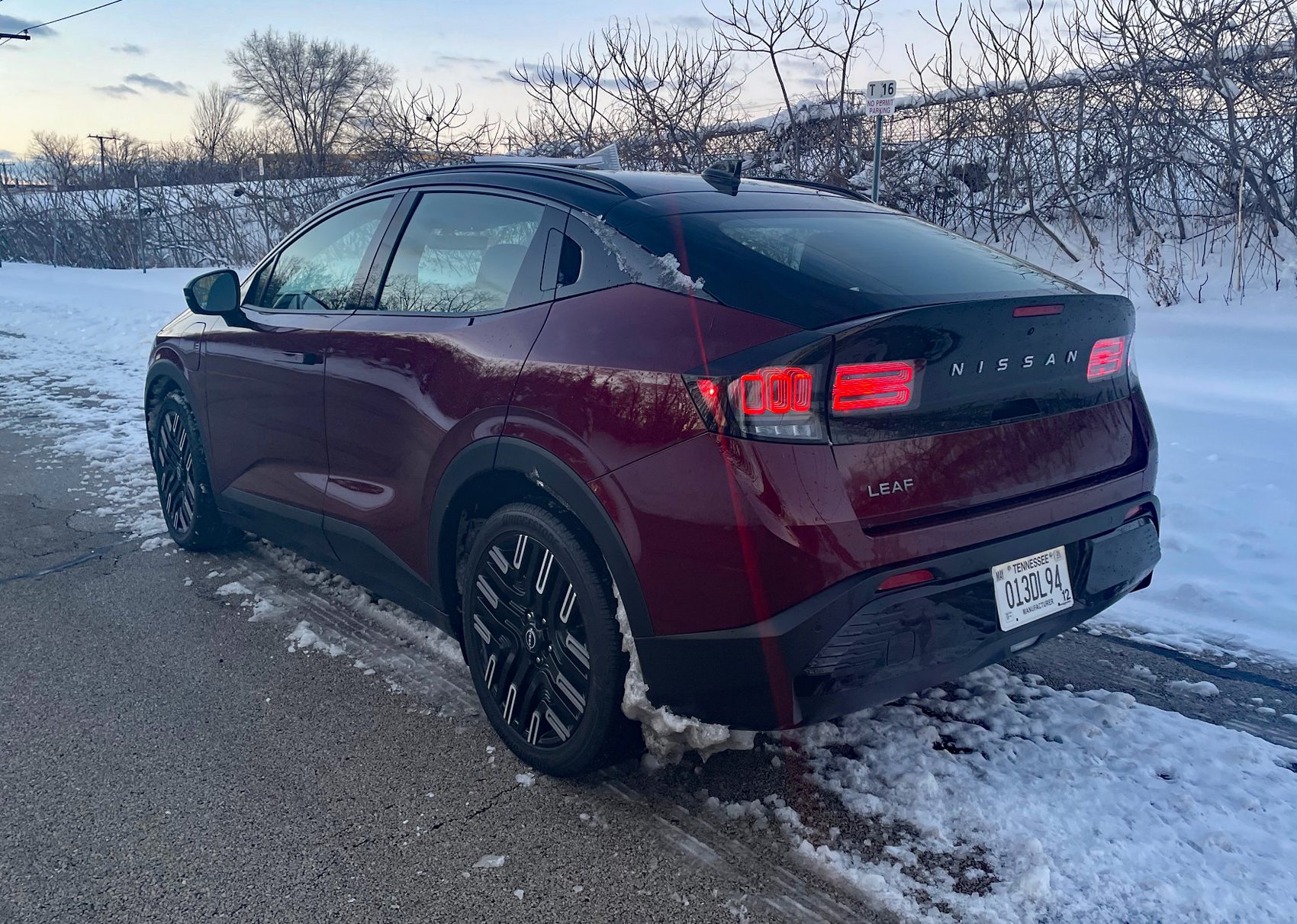
For 2026, Nissan completely redesigned its long-standing EV, bequeathing it a true crossover design, much improved driving range, and, perhaps most importantly, accessible pricing.

For 2026, the Leaf is offered in the following trim levels:
- S (price not yet announced)
- S+ ($31,485)
- SV+ ($35,725)
- Platinum+ ($40,485)
Powertrain
All 2026 Leafs feature a front-wheel-drive layout, and save for the base S, are equipped with a 75-kWh battery and 214-horsepower motor. Range varies by trim level, with the S+ being EPA rated at 303 miles on a full charge, the SV+ at 288 miles, and the Platinum+ 259. Though due to arrive during the 2026 model year, we would not be surprised to see the S introduced as an early 2027 model.
Dimensions
As we noted earlier, the Leaf became a crossover for the new year, though in truth isn’t much changed in overall size. The new Leaf is about 3 inches shorter overall, but about as high as the 2025 edition.

Inside the 2026 Leaf claims slightly less front-row headroom (though there is still generous space even for tall drivers), but slightly more leg, shoulder, and hip room. Rear-seat dimensions are also similar to the 2025, though legroom is down by more than an inch.
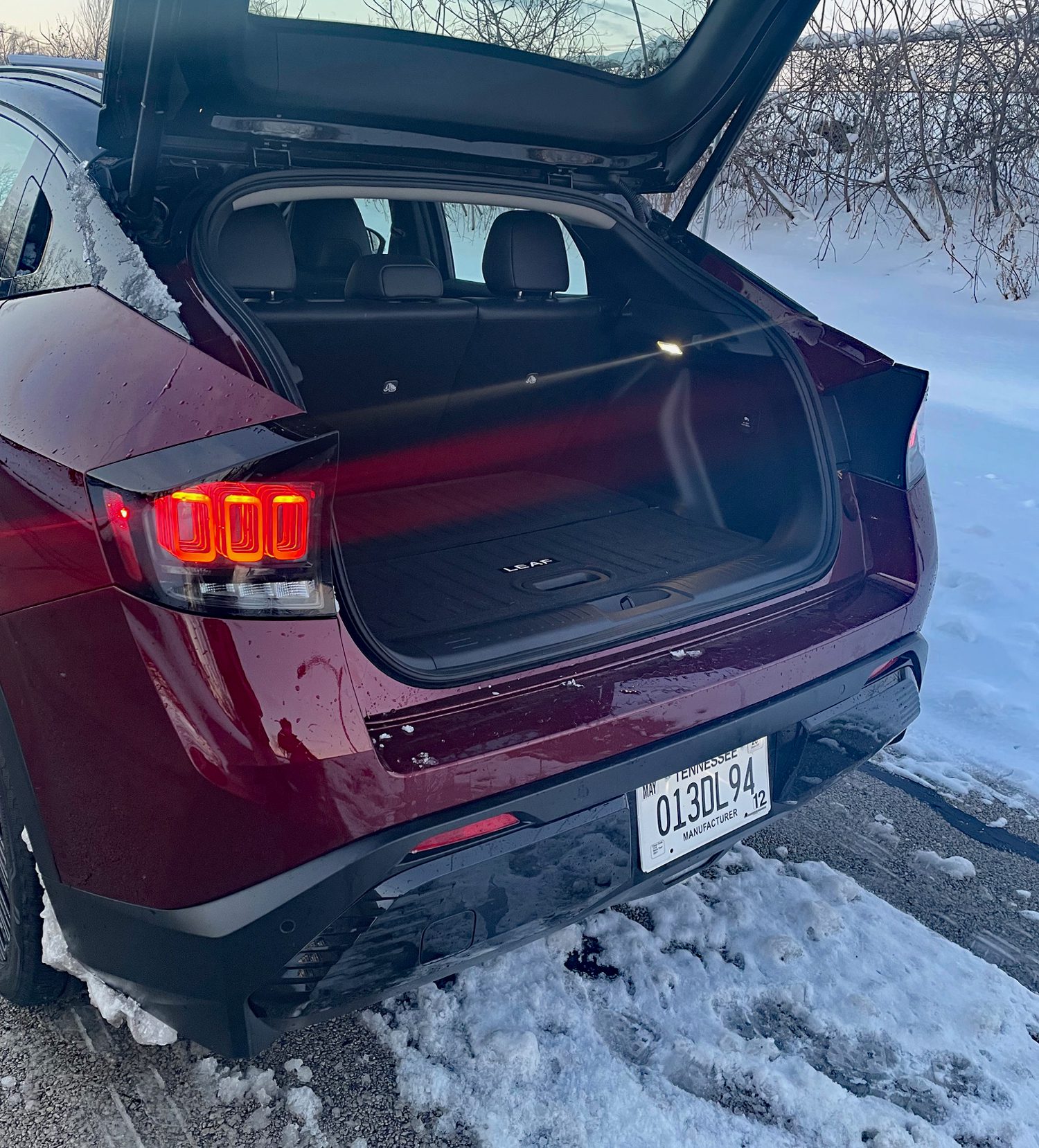
The big news is for 2026 is the massive leap in cargo space versus the outgoing model. While the 2025 Leaf provided roughly 30 cubic feet of stowage area with the rear seat folded flat, the redesigned Leaf boasts nearly 60 feet of room for diapers, camping gear, groceries, and dusty record collections.
Test Cars
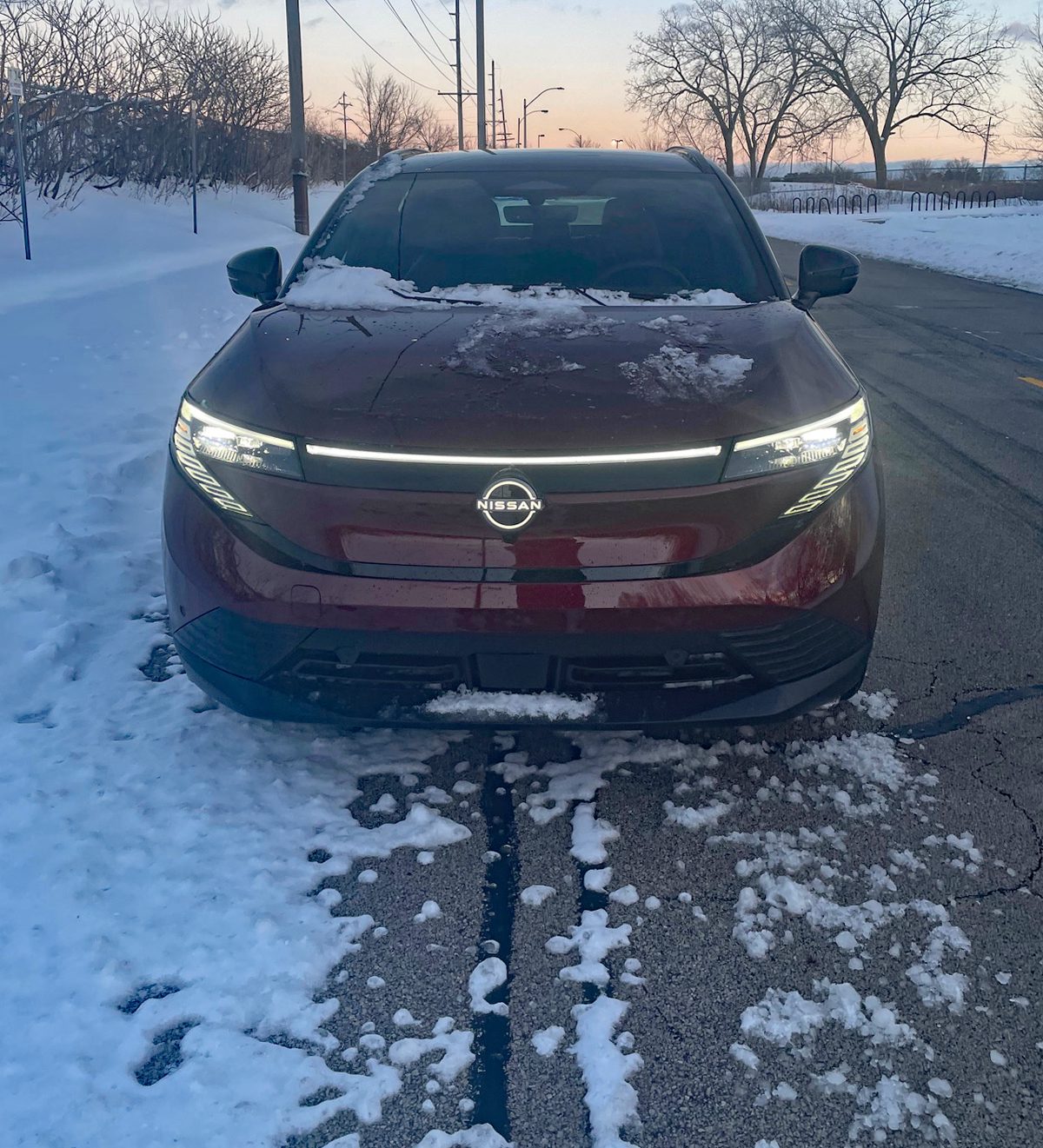
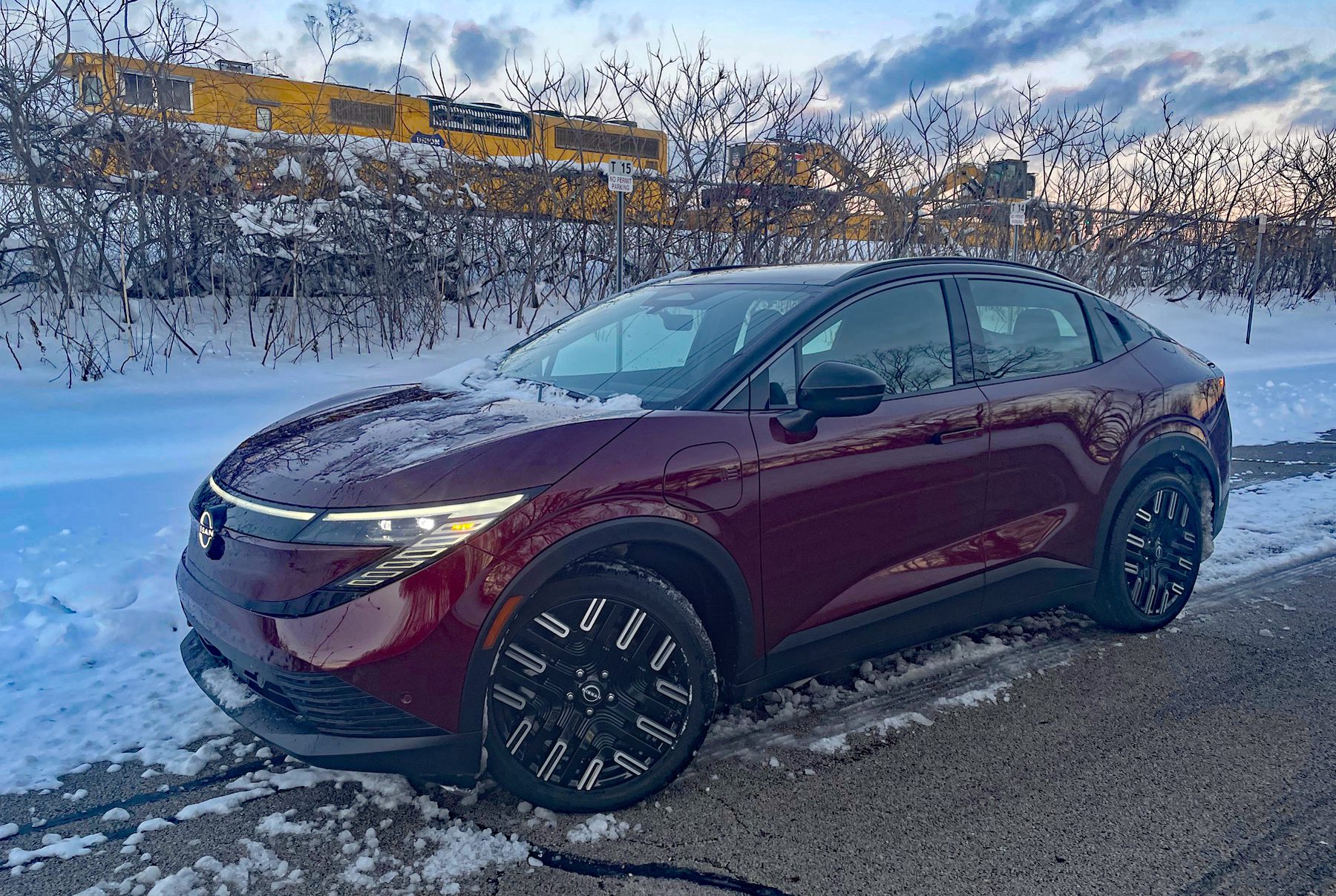
Consumer Guide recently spent a week behind the wheel of a 2026 Leaf Platinum Plus in 2-tone Coulis Red with Super Black trim. All told, our fully loaded test car came $41,930 including destination charge, and the optional battery heater, which we will talk about presently.
Cabin
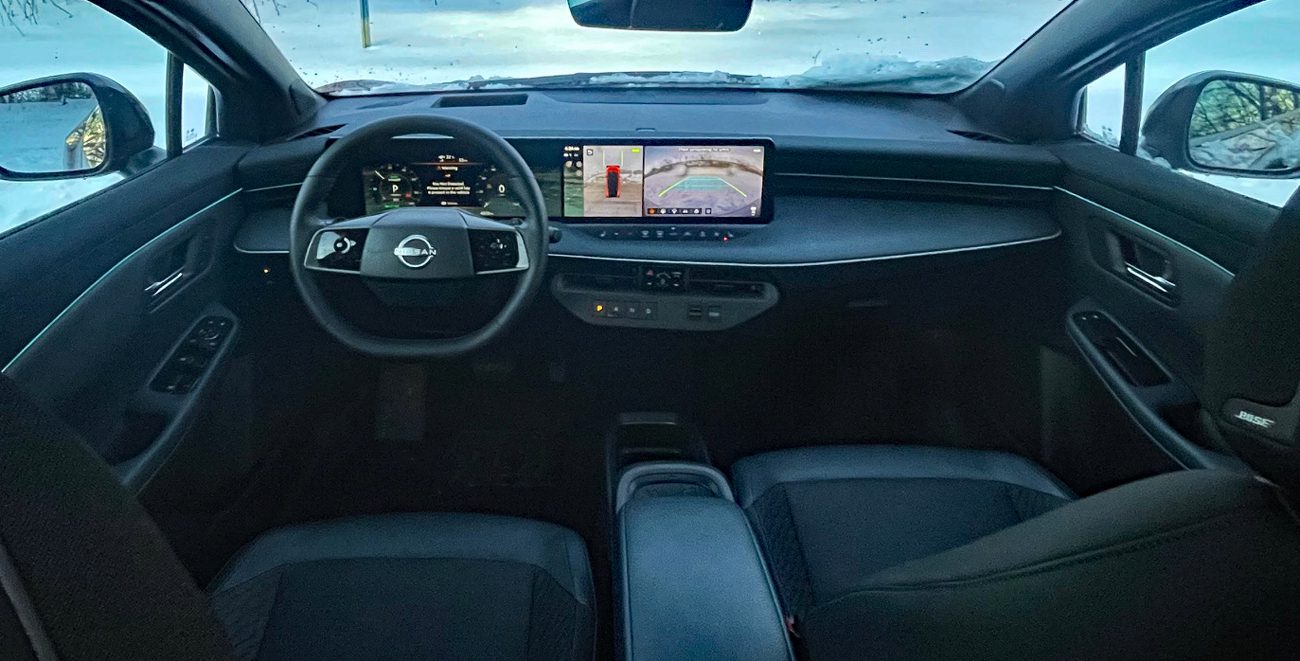
Inside, the Leaf looks clean and modern, with unnecesary design flourishes kept to a minimum. The electric Nissan employs the now trendy single-pane touchscreen and instrument panel (IP) setup, and to good effect. We found the IP clear and easy to read—and the range and battery condition information handy and easy to decipher at a glance—and the touchscreen layout simple, and logically arrayed.
Room and Comfort
There’s also plenty of adult space in the front row, with large door openings making easy work of ingress and egress. Second-row space is generally adequate, though tall occupants will find knee room limited behind taller front-seat passengers.
And though the cabin looks the role of a modern, efficient EV, the materials used to line the interior are comprised mostly of hard plastic. At this price point we can forgive the lack of soft-touch elements, but we had hoped for more.
Power and Performance
Under way you’ll find the Leaf—at least in non-S trim, dynamically engaging. There’s plenty of smooth power from a stop or once moving. While the Leaf is no rocket by EV standards, it is easily the acceleration equal of like-size gasoline-powered crossovers.
Ride and handling are also impressive. The Leaf can be hustled around corners with confidence, while ride quality at least matches that of Nissan’s Kicks non-EV small crossover–which is high praise.
Range
We drove the Leaf during a sudden cold snap here in the Chicago area, and found the car’s estimated range to be conservative. Our well-optioned, large-wheeled, Leaf is EPA estimated to travel 259 miles on a full battery charge. Despite the cold weather—which generally compromises battery performance—we estimate our Leaf would have traveled at least 280. This makes 300 miles a likely figure during periods of more mild temps.
Battery Heater
And speaking of the cold, our test car was equipped with an available battery heater. The heater can be employed to warm the EV battery to prepare it for fast charging. Accessed via the touchscreen, the heater is easy enough to engage, and can shorten cold-weather charging sessions. We did not have a chance to employ the heater, but suspect that, at $500, it’s worth the price.
Charging
The charging situation itself is something of a mixed bag, as the Leaf is equipped both with a traditional “CCS” charger port (front driver-side fender), and Tesla-style “NACS” port (front passenger side). Sounds simple, but here’s where things get complicated:
The CCS side accepts only level-1 (wall outlet) and level-2 (220-volt home charger) connections. This while the NACS side accepts only level-3 (DC “fast” charging) via a Tesla charging station. That said, the NACS port will accept an adaptor for use of non-Tesla charging stations.
It’s a lot to remember, but ultimately does provide a certain amount of charging flexibility moving forward, as the CCS system will eventually be replaced by the Tesla NACS standard nationwide. But, if you already have a level-2 charger at home, it’s likely CSS, and none of this is going to matter very much you—you’re all set.
Value
Nissan has described the newest generation of the Leaf an EV for consumers who have already owned an electric vehicle. This makes some sense, as the Leaf is offered in sensible price levels with good—though not outstanding—range, and good, if not crazy, power. In short, the Leaf is perfect for folks who have gotten past unrealistic range expectations, having learned that going 400 miles in a day is something they rarely do.
We named the Nissan Leaf to our 2026 Consumer Guide Best Buy list, and predict that this newest version of the maker’s pioneering EV will impress price-conscious electric-car shoppers with a combination of content and value that is difficult to ignore. And, for folks looking for an even better value, the coming S model promises to be a class bargain, depending on how it’s priced.

Listen to the Car Stuff Podcast
2026 Nissan Leaf Pictures