

By the early Fifties, it was clear to smaller automakers that the “Big Three” (General Motors, Ford, and Chrysler) were playing for keeps, and that independent car brands were just fighting for market-share scraps.
Independent Carmakers
While the larger carmakers seemed to stumble briefly when post-war production resumed, it wasn’t long before almost half of all American new cars were coming off of Chevrolet and Ford lots. Smaller makers realized that to remain even somewhat competitive, they needed to exploit market niches ignored by the Big Three.
Small Cars
And thus, Nash introduced the Metropolitan, a very small car sold for a very reasonable amount of money. Nash was, at the time, among the more prolific independent carmakers, with a lineup of conventionally size models, as well as Rambler models, the latter of which were ahead of their time, heralding the early Sixties arrival of such popular compact cars as the Dodge Dart and Ford Falcon.
Nash and Austin
The Metropolitan was much smaller than the Rambler, and its development was something of a risk for a small car company. To cut development costs, the Metropolitan was designed in the U.S., but manufactured by British carmaker Austin, using elements of vehicles already in production for European markets, including the engine.
Introduction
Introduced in 1954, the Metropolitan was considerably smaller than the Rambler, but featured familiar American design cues. From the get go, the new tiny Nash was offered both as a convertible, and hardtop coupe.
Specs
 The Metropolitan came in fully 26 inches shorter than the already tidy Rambler coupe, and though technically equipped with a rear seat, no sane passenger would voluntarily venture into the limited space aft of the front-row seats—especially in the convertible.
Power, too, was limited. Early Metropolitans were equipped with a 42-horsepower 1.2-liter Austin 4-cylinder engine. The engine would later be bumped to 1.5-liters and 55 horsepower. A buff-book review of a 1954 example quoted a 0-60 mph time of 22.4 seconds. Slow even by contemporary standards.
Reviews
That said, Metropolitan reviews were mostly positive, with the automotive media finding the little Nash sporty in character and fun to drive. The vehicles were also reportedly well built, and easy to operate.
Prices
For 1954, prices started at around $1500, about the same price as a like-year Volkswagen Beetle, and roughly $50 cheaper than the least-expensive Rambler, the Deluxe Sedan.
Print Ad
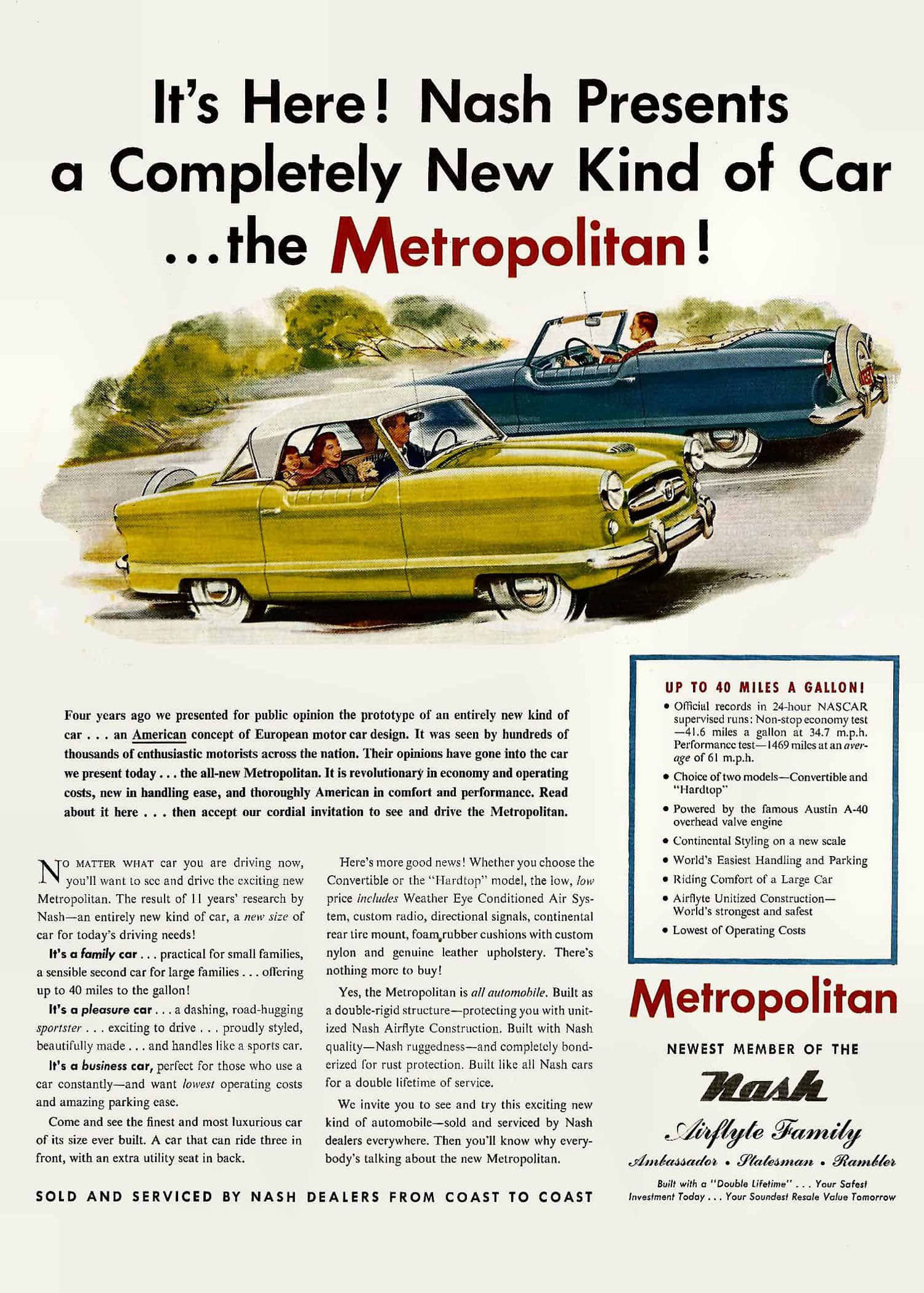
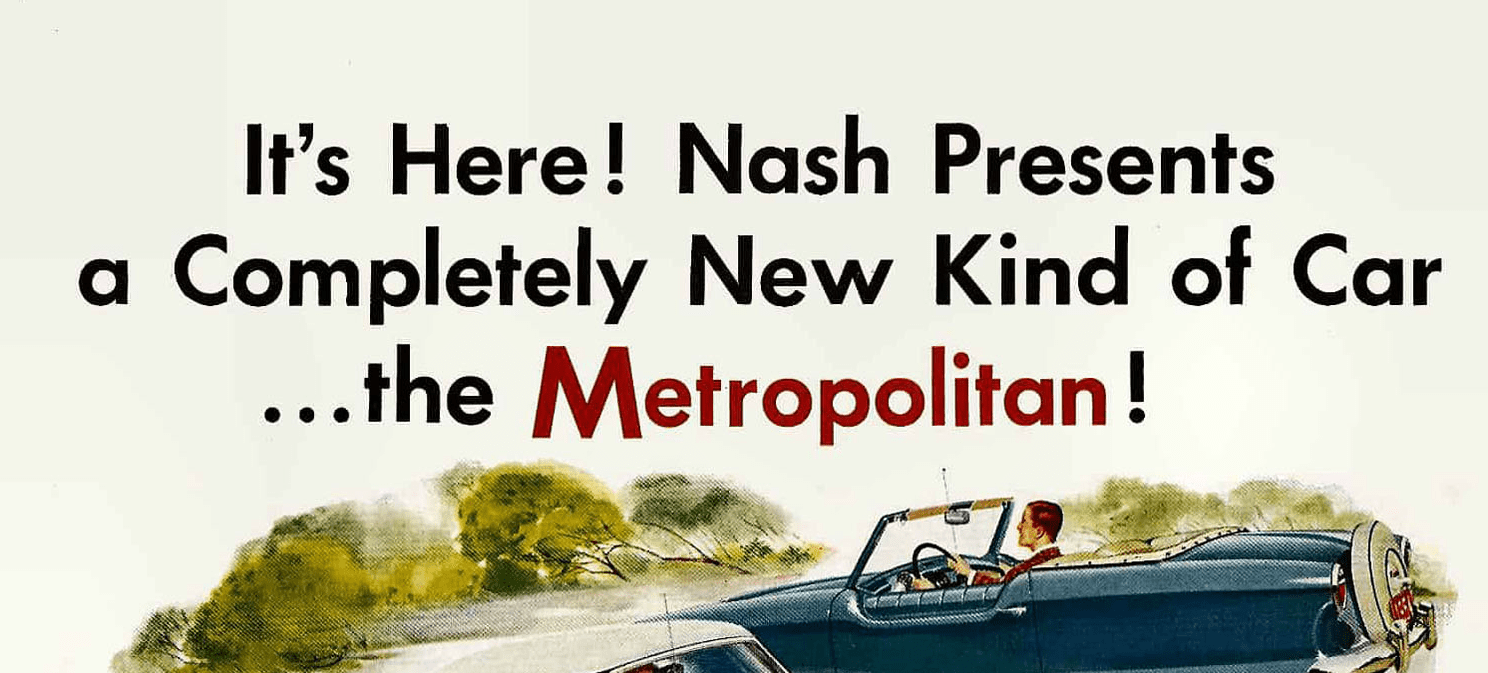
We appreciate this magazine ad for its optimism regarding American customers’ willingness to adopt truly small cars as an alternative to larger, less-efficient vehicles.
Sales
And on this point, Nash was half correct. While the small Rambler was actually quite popular, the Metropolitan never caught on. That said, the little Metro sold better than most folks probably assumed it might.
Nashed peddled more than 11,000 Metropolitans in 1954, with sales peaking at better than 20,000 units for 1959. While those numbers were rounding errors at General Motors, they were actually impressive for Nash, all things considered.
End of Production
Nash ended Metropolitan production after the 1962 model year. Interestingly, other carmakers never really learned from Nash’s Metropolitan efforts. Americans will buy small cars, but will not—for any sustained period of time–buy truly tiny cars.
Small Car Failures
Listed here are just a few examples of smaller-than-subcompact cars that made only brief appearances in U.S. showrooms:
Ford Aspire (1994-1997)
Pontiac LeMans (1988-1993)
Smart ForTwo (2009-2019)
Subaru Justy (1988-1994)
Toyota Starlet (1981-1984)
CG Says:
Though a curiosity today, the Nash Metropolitan was taken seriously in its time. As suggested in the ad seen here, the little Nash likely served families well as a low-cost second car, though may have proven less popular with traveling sales folk—especially those spending much time on the highway.
Nash would end up being absorbed by the vortex of independent car companies that became American Motors, with the Rambler brand enjoying a period of success as a stand-alone brand. As for the Metropolitan, the little cars are now much sought after by collectors, and by most accounts are fairly easy to keep running.
Listen to the Car Stuff Podcast
1954 Nash Metropolitan Edition Pictures
Click below for enlarged images