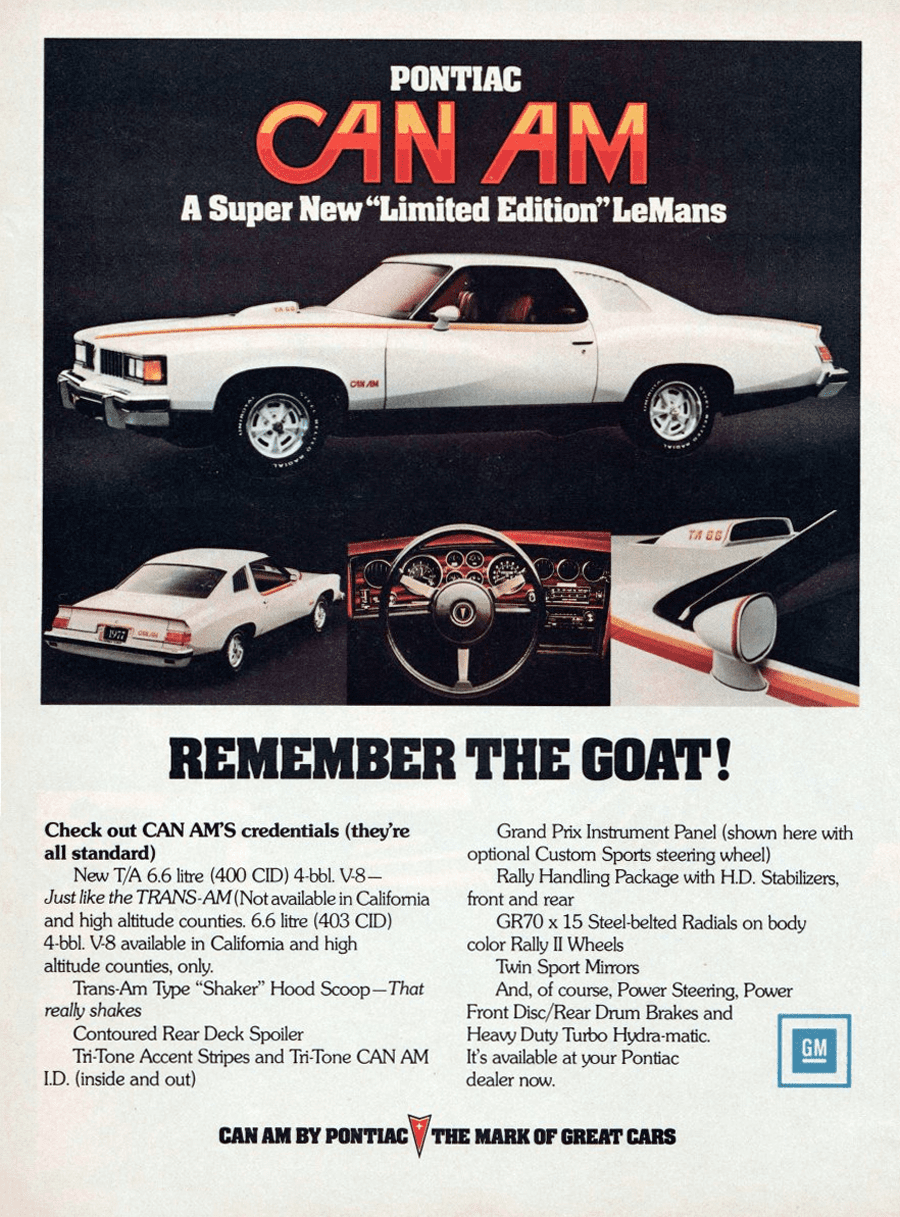

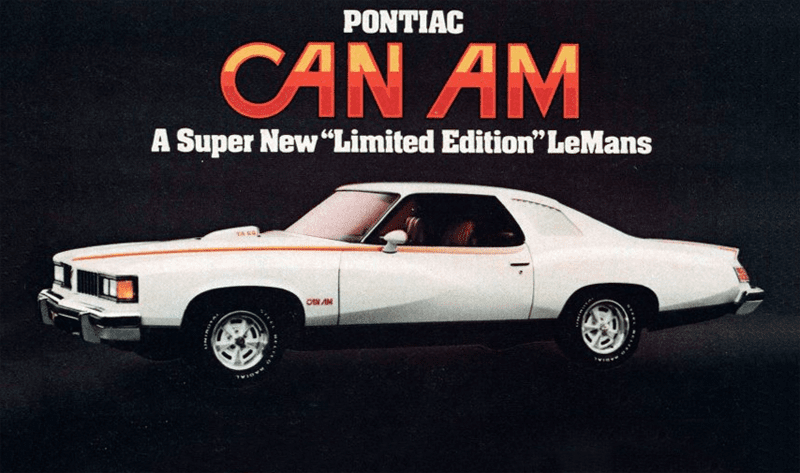
There are a couple of interesting elements of this 1977 Pontiac ad, both of which we’ll address momentarily.
But first, in perusing this ad, it’s important to remember that this advertisement—and the car featured—appeared during the depths of the “malaise era.” Malaise era is a term coined—long after the fact—to described the decade or so after federal emissions requirements and low-lead gasoline led to a serious drop in automotive engine horsepower. The consensus generally puts the era as the model years between 1973 and 1983. Mass adoption of fuel injection largely ended the malaise period, as makers were able to again deliver engines with compelling power numbers.
1977 Pontiac Can Am
Limited Edition
As for this ad, we’re struck by two interesting points. First, the ad suggests that the Can Am would be a “limited edition” model, but failed to drive home just how limited it would be. While Pontiac retailed more than 81,000 LeMans examples in 1977, just 1377 were Can Ams. And, this is key, 1977 was the only model year the Can Am was built.
The Goat
Secondly, while the ad mentions “The Goat,” it never actually mentions the legendary GTO. That pioneering muscle car was offered between 1964 and 1974. Pontiac began referring the GTO as The Goat in 1969 ads, but enthusiasts had coined and used the term much earlier. We can only assume that Pontiac marketers feared drawing too heavily on the GTO legend to market a car that, dulled by malaise circumstance, was but a shadow of the maker’s legendary muscle car. That said, we’d argue that the Cam Am was actually pretty cool, and certainly exciting by 1977 standards.
Real Muscle Car
Based on the midsize LeMans, the Can Am was a true muscle car by classic definition. It featured a large engine crammed under the hood of a midsize car—just like the GTO. And, just like the “Goat,” the Can Am boasted a few upgrades, including a beefed-up suspension, heavy-duty brakes, handling-oriented tires, and a sturdy transmission. The Can Am came only with a 3-speed automatic.
Engines
Power for most Can Ams came from a Pontiac-built 200-horsepower, 400-cubic-inch (6.6-liter) V8. California and high-altitude examples made do with a 185-horse Oldsmobile-sourced 403-inch mill (also 6.6-liter). The latter engine made up for most of its horsepower deficit with an abundance torque available low in the rev range.
Trans Am Engine
Fun fact: The hood-scoop badge on models equipped with the 400-inch engine read “T/A 6.6,” while Olds-engine-equipped examples came with badges that read simply, “6.6.” This because in 1977 the 400 was also found under the hood of Pontiac’s flagship Firebird Trans Am.
Colors
Of the Can Ams built, 1335 went to American customers, and just 42 to Canadian Pontiac fans. So, if you spot a Can Am with a metric speedometer, you’re looking at something pretty rare. Oh, and every Can Am left the factory in Cameo White (Pontiac paint code 11). If you see pictures of a black Can Am online—as we have—you’re looking at an aftermarket paint job.
Collectible
All things considered, we find the Can Am to be an impressive effort given the era of which it was born. Car collectors seem to agree. Sources suggest that just 300 Can Ams remain in existence, and that they generally trade for between $30,000 and $40,000. That said, at least one well-preserved ‘Am commanded more than $80,000 at auction.
So, maybe the Can Am is something of a pretend muscle car, but it’s also pretty cool. And it’s totally in the spirit of original GTO. Remember the Goat, indeed.

Listen to the Car Stuff Podcast
Pontiac Can Am Pictures
Click below for enlarged images